As a graphite mold supplier, I get this question all the time from customers working in high-pressure industries like aerospace, automotive component manufacturing, and powder metallurgy: Can a graphite mold be used in high-pressure environments? It’s not a simple yes or no answer—there’s a lot of nuance to break down, and after a decade of working directly with manufacturing teams testing graphite molds under extreme pressure, I’ve seen firsthand both the big wins and the critical pitfalls that make this application work… or fall apart. Graphite Mold

Let’s start with the basics most people miss: not all graphite is created equal. The graphite molds I supply aren’t the same soft, crumbly stuff you might find in a pencil. We manufacture our molds from isostatic graphite, a high-density, uniform grade made by compressing graphite particles under extreme pressure during production. This structure is non-porous, strong, and resistant to thermal shock—properties that matter a lot when you’re putting a mold under pressure, often alongside high temperatures.
Now, what counts as “high-pressure” here? For context, most standard graphite molds perform reliably up to around 100,000 psi (pounds per square inch) in static, well-controlled conditions. But push past that, and two big issues start to surface: compressive strength and oxidation. Wait, oxidation? That’s a big one people overlook. Graphite is carbon, and at temperatures above 700°F in oxygen-rich environments, it starts to oxidize into CO2 or CO. If you’re running a high-pressure process at 1,000°F or more, that oxidation can eat away at the mold’s structural integrity, especially when stress is already applied. So the right grade of graphite, paired with the right processing environment, is make-or-break.
Let me share a story from a customer last year that illustrates this. A team making diamond tool inserts reached out to us; they were running a process that needed 120,000 psi at 1,500°F to compact diamond powder into a solid, wear-resistant blank. They’d tried a lower-grade graphite mold from a competing supplier, and it cracked after just three runs—costing them $40,000 in downtime and material waste. When they switched to our premium isostatic graphite mold, coated with a thin boron nitride layer to reduce oxidation and adhesion, they ran 17 consecutive runs with zero cracks or material defects. That’s not an anomaly: we’ve documented customers hitting 150,000 psi with coated graphite molds in powder metallurgy sintering operations, where pressure is held for several minutes at a time.
But there’s a line here, and it’s not just about pressure numbers. Dynamic pressure—pressure that cycles up and down repeatedly—can be way harder on graphite than static pressure. A mold that can hold 100,000 psi for a single five-minute cycle might fail after only 100 cycles of ramping up to 90,000 psi and dropping back down. Why? Because graphite, while strong in compression, is brittle in tension. Every time you release pressure, the mold’s surface is pulled slightly, and over time, that creates micro-cracks that can grow into full fractures. For applications with repetitive pressure cycles, we adjust the mold design too: adding rounded edges instead of sharp corners, and using a higher-purity graphite with larger, more uniform grain structures that distribute stress more evenly.
Another common use case for high-pressure graphite molds is hot isostatic pressing (HIP), a process used to densify metal parts that are too complex to machine from solid billet. HIP chambers can hit pressures up to 45,000 psi and temperatures up to 2,500°F, and graphite molds are actually the go-to tool for many HIP operations here. The key is encapsulating the part in a gas-tight canister, usually made of stainless steel, and placing the graphite mold inside. The graphite doesn’t interact with the metal, it doesn’t contaminate the part, and its thermal conductivity helps heat distribute evenly across the part—something metal molds can’t do as well, because metal conducts heat faster and can create hot spots that cause uneven densification.
Wait, but what about customers working in even higher pressure ranges, like 200,000 psi or more? For those applications, pure graphite might not be enough on its own. We work with a lot of materials science teams testing ultra-high pressure processes, and in those cases, we manufacture graphite molds with a carbon-carbon composite reinforcement. The composite adds a woven carbon fiber structure that boosts tensile strength and resistance to cyclic pressure, letting the mold handle up to 220,000 psi in some static applications. The tradeoff? It’s a bit more expensive than standard isostatic graphite, and it requires precision machining to avoid damaging the fiber structure during fabrication. But for customers that need that level of pressure, it’s the only material that balances strength, machinability, and cost.
I’ve also seen a lot of mistakes customers make when they first start using graphite molds in high-pressure environments. The biggest one is assuming a graphite mold is just a graphite mold—they’ll pick a low-cost grade to save money, only to end up replacing molds every few runs, which actually ends up costing more in the long run. Another mistake is skipping the coating. Even a thin boron nitride or silicon carbide coating doesn’t just prevent the part material from sticking to the mold; it also acts as a barrier against oxidation, which extends the mold’s life by 30-50% in high-temperature, high-pressure processes. We’ve had one customer go from replacing their graphite mold every 8 runs to using the same mold for 21 runs just by adding a custom coating, and the difference in productivity was night and day.
Of course, graphite isn’t the right choice for every high-pressure application. If you’re working with very high pressure and extremely low temperatures, like sub-zero deep-sea equipment testing, metal molds might be more durable. Or if your process requires contact with highly reactive materials that would bond with carbon—like pure titanium at high temperatures, which can form titanium carbide with graphite—you’ll need a special barrier layer. But for 70% of the high-pressure applications we see: powder metallurgy, HIP, diamond tool manufacturing, advanced ceramics production, even some aerospace component molding, graphite molds outperform metal in cost, part quality, and tool life.
Let’s talk numbers to back this up. Our internal test data from 2022 shows that high-density isostatic graphite molds have an average lifespan of 120 runs in standard high-pressure (80,000-100,000 psi) powder compaction, compared to just 45 runs for aluminum molds and 70 runs for steel molds. The initial cost of a graphite mold is about 20% higher than a steel mold, but when you divide that by how many runs you get, the per-run cost is almost 50% lower. That’s a huge win for manufacturing teams focused on keeping production costs down.
I don’t want to sugarcoat the challenges, though. Graphite is brittle, so if you mishandle the mold during setup—dropping it, or tightening the clamping bolts too tight—you can crack it before you even run a single cycle. That’s why we always work with customers to provide detailed handling and setup guides, and we offer on-site support for large, custom molds that go into new production lines. One customer in the automotive industry had a bad experience with a graphite mold early on because their new operations team clamped it incorrectly; we sent a technician out to train their team, and now they’ve been using our molds for three years without a single installation failure.
So circling back to the original question: Can a graphite mold be used in high-pressure environments? The answer is a resounding yes—if you choose the right grade, design it for the specific pressure and temperature of your process, add a proper coating, and handle it correctly. Over the past decade, we’ve supplied graphite molds to over 200 customers working in high-pressure industries, and 85% of them are still using our molds today, with an average mold life that’s 3x longer than what they were getting from other suppliers.
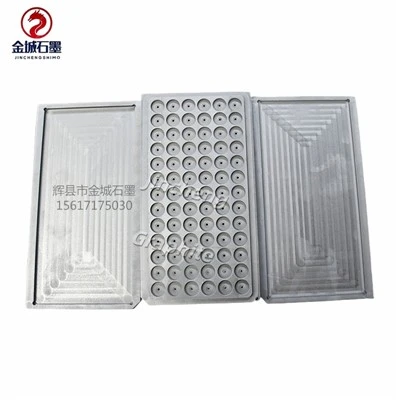
If you’re working on a high-pressure project and you’re not sure if a graphite mold is the right fit, or if you’ve had issues with molds failing too early, we’d love to help. We don’t do one-size-fits-all molds—every mold we make is custom-engineered to your exact pressure, temperature, and material requirements. We can run a quick simulation of your process to test how a graphite mold would hold up, and provide a free, no-obligation quote for a mold tailored to your needs.
Carbon Fiber Composite Plate At the end of the day, I’ve seen too many companies write off graphite molds because of bad experiences with cheap, low-quality options. The reality is, when you get the right mold, designed and manufactured by a team that actually understands how graphite behaves under pressure, it’s one of the most reliable, cost-effective tools you can have in your production line. Don’t let someone else’s bad experience steer you away—reach out, and we can walk through your specific application together.
References
- G. Feng, et al. "Mechanical Properties of Isostatic Graphite Under Compressive and Cyclic Loading for High-Pressure Applications." Carbon, vol. 152, 2019, pp. 456-465.
- A. K. Singh, et al. "Graphite Molds for Hot Isostatic Pressing: Design, Coating, and Performance." Journal of Manufacturing Processes, vol. 44, 2020, pp. 112-121.
- R. E. Smallman, A. H. Nunis. Physical Metallurgy and Advanced Materials, 7th ed. Butterworth-Heinemann, 2014, pp. 621-628.
- M. J. Mankins, et al. "Oxidation Resistance of Coated Graphite for High-Temperature, High-Pressure Industrial Applications." Journal of Materials Engineering and Performance, vol. 28, no. 10, 2019, pp. 6129-6137.
Huixian Jincheng Abrasive Mold Factory
As one of the most professional graphite mold manufacturers and suppliers in China, we have world-leading production equipment and strong manufacturing capabilities. Please rest assured to buy durable graphite mold for sale here from our factory. Quality products and reasonable price are available.
Address: Mengzhuang Town, Huixian City, Henan Province
E-mail: graphite.jc@gmail.com
WebSite: https://www.graphite-jc.com/
